Authority Control in Archives and Special Collections
Every heading and cross-reference in an authority record adds to your catalog’s web of access points, enhancing discovery and putting relevant content into a patron’s hands.
Maintaining authorized name and subject headings across thousands or even millions of records is a perpetual challenge. Automation makes authority control manageable, but some librarians are hesitant to turn their catalogs over to a one-size-fits-all algorithm.
We believe that partnering with an authority control vendor should give you more control over your catalog, not less.
In this webinar, Backstage’s Casey Cheney explores factors that affect the authority control needs of special collections, whether within a larger institution or as a standalone library or archive. She discusses common processing choices among our special collections clients and how to select these options in your Backstage profile.
Authority Control in the Academic Library
Every heading and cross-reference in an authority record adds to your catalog’s web of access points, enhancing discovery and putting relevant content into a patron’s hands.
Maintaining authorized name and subject headings across thousands or even millions of records is a perpetual challenge. Automation makes authority control manageable, but some librarians are hesitant to turn their catalogs over to a one-size-fits-all algorithm.
We believe that partnering with an authority control vendor should give you more control over your catalog, not less.
In this webinar, Backstage’s Casey Cheney explores factors that affect an academic library’s authority control needs. She discusses common processing choices among our academic library clients and how to select these options in your Backstage profile.
Authority Control in the Public Library
Every heading and cross-reference in an authority record adds to your catalog’s web of access points, enhancing discovery and putting relevant content into a patron’s hands.
Maintaining authorized name and subject headings across thousands or even millions of records is a perpetual challenge. Automation makes authority control manageable, but some librarians are hesitant to turn their catalogs over to a one-size-fits-all algorithm.
We believe that partnering with an authority control vendor should give you more control over your catalog, not less.
In this webinar, Backstage’s Casey Cheney explores factors that affect a public library’s authority control needs. She discusses common processing choices among our public library clients and how to select these options in your Backstage profile.
Project Management in Practice in Libraries
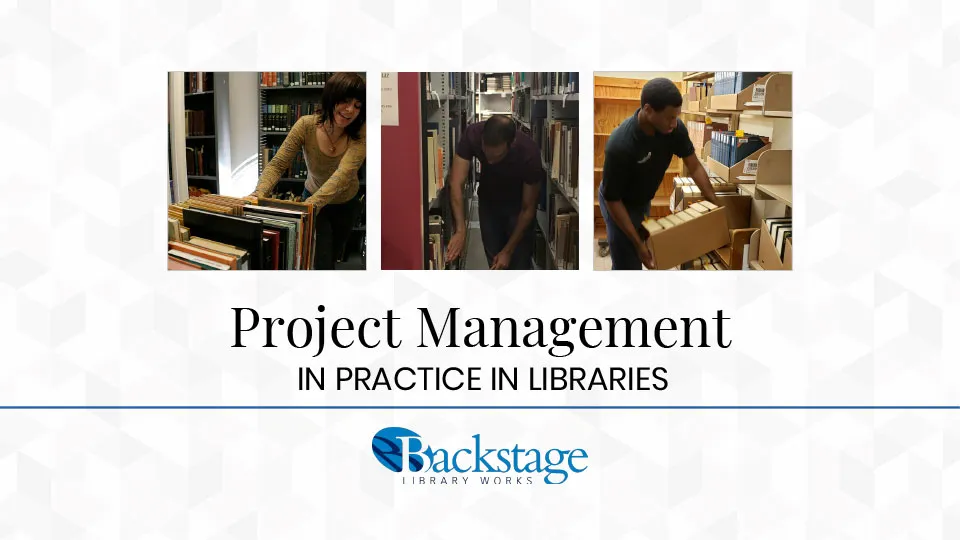
As information professionals, our calendars are filled with scheduled meetings, routines, and ongoing workflows. We have to be flexible to make room for unplanned encounters and emergencies. We also frequently take on projects large and small, simple and complex.
Thoughtfully identifying the projects that come up in the course of our work allows us to define their parameters, intentionally bring to bear project management tools and best practices, and successfully deliver on the goals of our stakeholders.
In this webinar, Jacob Bastian, vice president of collection management services at Backstage, explores key concepts of project management and applies the discipline to a library setting. He also gives real-world examples, drawing on years of experience leading collection management projects in libraries.
From Paper to Film: Microfilming and USNP at UIUC

Digitized newspapers are an invaluable resource for searching local history and genealogy. Today’s digital newspaper collections owe much of their content to microfilm produced for the U.S. Newspaper Program (USNP) from 1982 to 2011. But what role does microfilm play in the preservation efforts of a modern library?
In this webinar, guest presenter William Schlaack, digital reformatting coordinator at the University of Illinois at Urbana-Champaign, shares how microfilm fits into the University Library’s preservation program. He explains why and how UIUC continues to expand its microfilm collections, presents an overview of the microfilming process, and discusses considerations to ensure that your microfilm collections are ready to digitize.
Documenting Contemporary Regional History: The Utah COVID-19 Digital Collection
In March, as businesses, schools, and libraries began to shut down, history was being made. Documenting these events at a local and regional level presented opportunities and challenges. How do you gather and organize the digital artifacts of an emergency situation when connecting with the community is complicated by the emergency itself?
In this webinar, guest presenters Jeremy Myntti, Anna Neatrour, and Rachel Wittmann relate their approach to creating — and continuing to develop — the Utah COVID-19 digital collection at the University of Utah J. Willard Marriott Library. They discuss born-digital content, metadata, permissions, and use scenarios.
Jeremy Myntti is interim Associate Dean for Collections and Scholarly Communication at the Marriott Library. His research interests revolve around making library collections more discoverable and accessible to patrons.
Anna Neatrour is Interim Head of Digital Library Services and Digital Initiatives Librarian at the Marriott Library. She enjoys working on collaborative digitization projects and exploring topics in digital humanities.
Rachel Wittmann is the Digital Curation Librarian at the Marriott Library. In her role, she creates metadata for digital collections, develops digital exhibits, and enjoys exploring ways to interpret metadata with data visualizations.
Quality Management in Digitalization: Examining Workflows with ISO 9001
If you’ve worked with digitization projects in libraries or archives, you’ve heard of standards like the Federal Agencies Digital Guidelines Initiative (FADGI). These standards provide our community with benchmarks and best practices for creating consistent digital images. But what other standards are useful in this field?
In this webinar, Dan Zellner, digitization manager at Northwestern University, leads a discussion of ISO 9001:2015, an international standard for establishing quality management systems. ISO 9001 is used across a range of industries and public sector institutions. The Northwestern University Library has found it to be a useful framework for analyzing digitization workflows and refining processes through data-driven adjustments.
Launching a Successful Digital Archives Initiative
Distance learning is an increasingly important tool for connecting academic and cultural institutions with their communities. Librarians and archivists who interact with distance learners extend the impact, reach, and value of their analog archival collections through digitization.
This webinar is a joint presentation featuring Kelly Barrall from Backstage Library Works with Katie Gambone and Jessica Kowalski from Adam Matthew Digital’s Quartex team. They discuss key steps your institution should consider to successfully launch a digital archives initiative and the role vendors can play in accelerating the process of making this digital content available to your users.
About Quartex — Adam Matthew Digital is an award-winning publisher of primary source content with 30 years’ experience curating and showcasing archival collections. Through this experience, we have developed Quartex, a platform designed to help libraries, archives, and other heritage institutions showcase, share, and celebrate their digital collections.
Cataloging Zines: Discovery for Micro-Publications and Niche Collections
Zines create a fleeting snapshot of culture, often with a tight focus on a specific time, place, and like-minded community. Libraries are increasingly curating zine collections for circulation to readers and to preserve as history. However, the non-traditional nature of these publications raises practical questions for how to manage them in a discovery environment.
In this webcast, guest presenter Nicole Lewis explores zine collections from a bibliographic standpoint. She covers decisions to be made in cataloging zine collections, MARC fields that merit particular attention, and useful online resources from libraries and the zine community.
Nicole Lewis is the lead cataloger at the University of Utah’s J. Willard Marriott Library. She is responsible for coordinating cataloging workflows, LMS system administration for cataloging and acquisitions, and she performs cataloging for zines and a variety of other materials. Prior to her current position, Nicole worked at Backstage Library Works for a number of years.
DIY Catalog Maintenance and Authority Control: Tips, Tricks, and Ideas for Tuning Up Your Catalog In-House
Discovery in a library catalog relies on clean, consistent, and accurate metadata. Maintaining and improving catalog data as records come in from a wide range of sources is an ongoing challenge. The recent shift to remote access makes good metadata even more vital for patrons.
At the same time, remote work has opened new opportunities to dedicate staff time to taking on inconsistencies in the catalog. With a bit of planning and coordination, data cleanup and enhancement projects can provide useful and productive ways to work from home and may also facilitate engagement with our disconnected teams.
In this webinar, guest presenter Stacey Wolf, cataloging and metadata librarian at the University of North Texas, shares ideas for metadata improvement exercises, discusses tools to effectively discover and correct errors, and directs you to resources to help you get started.