Digitizing Your Photographic Collections
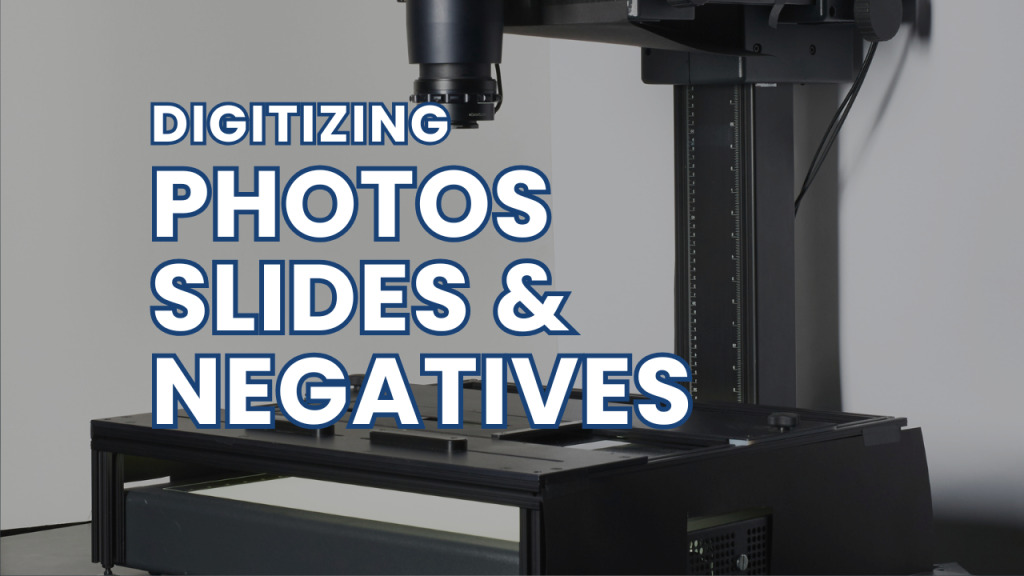
Photographic formats can range from prints to individual slides and negatives to short strips or longer reels. Historically, the glass and metal plates of the 19th century gave way to plastic films in the 20th century. Formats became more standardized, and the stability and longevity of films and prints improved. A film collection spanning even a few years may include several formats that each pose different challenges. So where do you start?
In this webinar, Kelly Barrall, vice president of digitization services at Backstage Library Works, guides you through a range of film formats and offers suggestions on what to consider to get the best results when digitizing your materials.
ILS Migration Migraine: Tips for Prevention and Recovery
Moving to a new ILS is an enormous undertaking that involves stakeholders from across the org chart. The library catalog is one core aspect of an ILS change. What steps can you take to prevent the predictable headaches of your bibliographic data transition? What can you do to optimize your metadata before a move? What problems may pop up during the process? And what remediation might be necessary after you transfer your MARC records? In this webinar, Casey Cheney, vice president of automation services at Backstage Library Works, maps out common issues and opportunities that librarians encounter with their catalog metadata during an ILS migration. In this webinar, Casey Cheney, vice president of automation services at Backstage Library Works, maps out common issues and opportunities that librarians encounter with their catalog metadata during an ILS migration.
Cataloging Surrogate Capture Demonstration

This demonstration is taken from our webinar, Cataloging at a Distance: Capturing Surrogate Images for Remote Catalogers. Here, Jake Bastian talks through the process of scanning a book using our Scan-to-Catalog kit.
Kits include:
- Laptop (with charger, mouse, and pad)
- CZUR Shine Ultra Pro Scanner (with power cable, USB cable, foot pedal, and capture area mat)
- Hard drive with USB cable
- Supplies (whiteboard, markers, eraser, ruler, acid-free paper flags, lint roller, and screen wipes)
Contact Backstage for more information and a guide for what images to capture when generating cataloging surrogates.
Cataloging at a Distance: Capturing Surrogate Images for Remote Catalogers
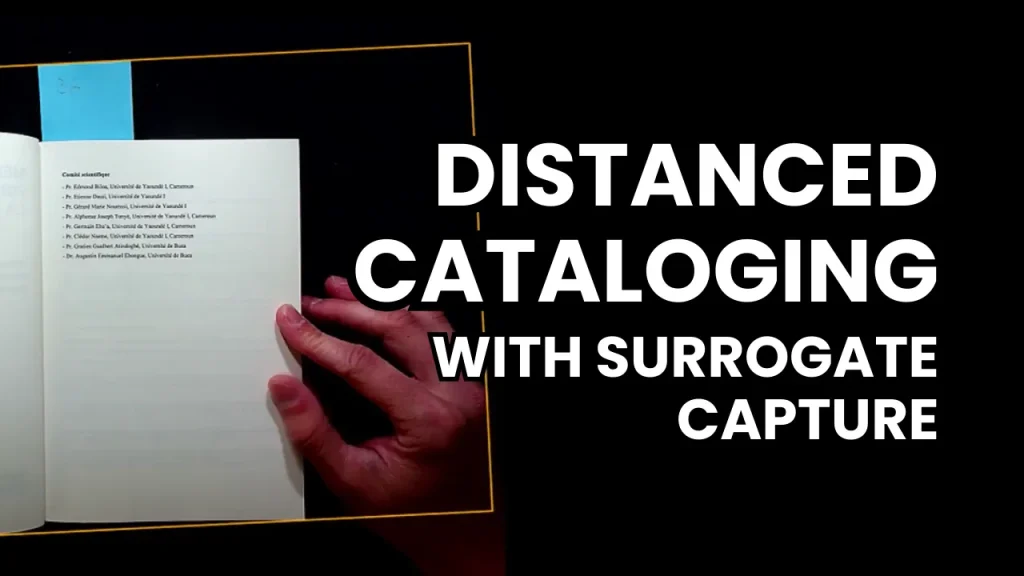
Metadata operations in libraries aren’t public-facing. They generally aren’t high-profile. But organizing information is at the heart of librarianship, and cataloging makes access possible.
Creating cataloging surrogates can empower a library’s metadata team to streamline workflows, to operate with greater flexibility, to cultivate a network of language, format, and subject expertise, and ultimately, to increase access to collections.
In this webinar, Jake Bastian, vice president of collection management services at Backstage Library Works, explores the practice of creating and working with cataloging surrogates, the reasons for adopting this tool, and how to integrate surrogates into your cataloging workflows.
What’s in the Box? Understanding Your Microfilm Collections
Over the last century, libraries around the world have preserved countless newspapers, books, and archival collections on microfilm. Some microfilm reels were produced for distribution and widely circulated, while others contain the best surviving copy of unique local history and genealogy resources.
When was the last time you considered your institution’s microfilm collections? Do you have acetate film, susceptible to vinegar syndrome? Is the content findable in your catalog? Which resources would be of interest to your community if they were easier to discover and access? Where do you even start?
In this webinar, Beth Brevik, account manager and former microfilm project manager at Backstage Library Works, leads you through exploring your microfilm collection, understanding what you have, assessing potential risks, considering long-term preservation, and finding ways to make these largely hidden collections available to your patrons.
History of MAPS – Micrographic Preservation Service (1992)

MAPS was founded in 1985 by five research libraries: Columbia University, Cornell University, New York Public Library, New York State Library, and Princeton University. Their goal? “To adhere to the highest standards of preservation microfilming, and to create a high quality, low cost microfilming service for nonprofit organizations.” An alliance between MAPS and OCLC was formed in 1990 and, in 2009, the former MAPS center became a part of Backstage Library Works.
In 2024, this video was rediscovered by members of our Microfilm and Digitization teams and restored. As we watch through it, it’s fascinating to see how much has changed in the decades since, and how much remains the same. What has persisted is a dedication to the preservation of heritage materials, utilizing workflows that ensure high-fidelity capture of original materials.
Structured Data Extraction Using Artificial Intelligence | Doxie.AI
Vijay Singh, President of Doxie.AI delves into the use of artificial intelligence to identify, categorize, and extract textual data from digital image sources in government documents, library special collections, and archival materials. Artificial intelligence allows Doxie to work far beyond the limited capabilities of an OCR engine, identifying text that is out of alignment, obscured, or even handwritten, and extracting key elements to build database content that increases discovery and makes digital image collections searchable with the data points that are most meaningful to users.
DEI Subject Heading Enhancements at Deschutes Public Library
In this webinar, Casey Cheney, Vice President, Automation Services at Backstage Library Works, and Emily O’Neal, Technical Services Manager at Deschutes Public Library, explain how they applied the concepts of Diversity, Equity and Inclusion (DEI) to change problematic terminology within the library catalog.
Hear a firsthand account of how a library can start building a more inclusive catalog that serves all users.
Backstage Tour: Digitization Studio
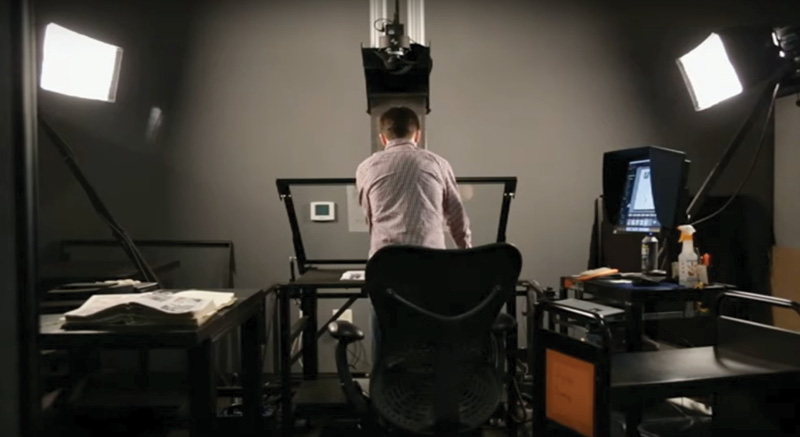
Step behind the scenes at the Backstage studio in Bethlehem, Pennsylvania, where you’ll follow the lifecycle of a digital imaging project from arrival to completion.
Authority Control: Consistency Among the Changes

How do you handle authority records when outdated Library of Congress headings don’t reflect your library’s policies for inclusion?
Authority control enhances discovery in your library’s catalog, disambiguating similar headings while collocating and cross-referencing related terms.
Updates from external sources, like Library of Congress name and subject headings, change the preferred terminology over time. Left uncontrolled, older records will use different terms for a person or topic than newer records, impeding search.
But authority control is more than just housekeeping. Some metadata librarians are using local authority practices to more respectfully recognize marginalized groups or to proactively decolonize their catalogs, replacing outdated terms still in use by national authority files with preferred terminology in their local records.
In this webinar, Casey Cheney, vice president of automation services at Backstage Library Works, explores external and internal changes that can affect headings in a library catalog. She discusses how leveraging automation can help a library’s metadata team manage updates and propagate decisions made at a local level. She also answers audience questions.