
Optimizing Catalog Metadata: Ensuring Discovery and Access in Our Libraries
In the wake of a sudden shift toward remote access, librarians are re-assessing priorities in making collections accessible to patrons who are unable to visit the physical library. Metadata maintenance efforts can be crucial to facilitating this change.
In this presentation, guest speaker Tom Adamich explores the challenges and opportunities of a renewed focus on library metadata. He’ll discuss assessment and optimization of catalog data, as well as the roles a vendor might play in support of a library’s plans.
Tom Adamich is a professor and technical services and reference librarian at Monroe County Community College, and president of the Visiting Librarian Service.
Automation in Discovery: Authority Control and Beyond
Authority control is widely recognized as an important means of maintaining connections in a library’s catalog, collocating related names or subjects, disambiguating similar titles or creators, and optimizing these access points for patron searches.
Automation that applies rules uniformly across your catalog, drawing on authorized terms from recognized databases, is the only practical means of propagating authority control throughout a large collection. But what else can an automation engine do? Where else can programmatic routines that search, match, and verify data points be applied?
In this webinar, Casey Cheney, vice president of automation services at Backstage Library Works, explores the possibilities of automation in MARC and non-MARC databases. She discusses how Backstage has applied data-matching algorithms to a wide range of metadata cleanup and enrichment projects. She also walks attendees through Backstage’s core authority control processes and answers audience questions.
Digitization, Metadata, and CONTENTdm: Partnering to Build Your Digital Collections
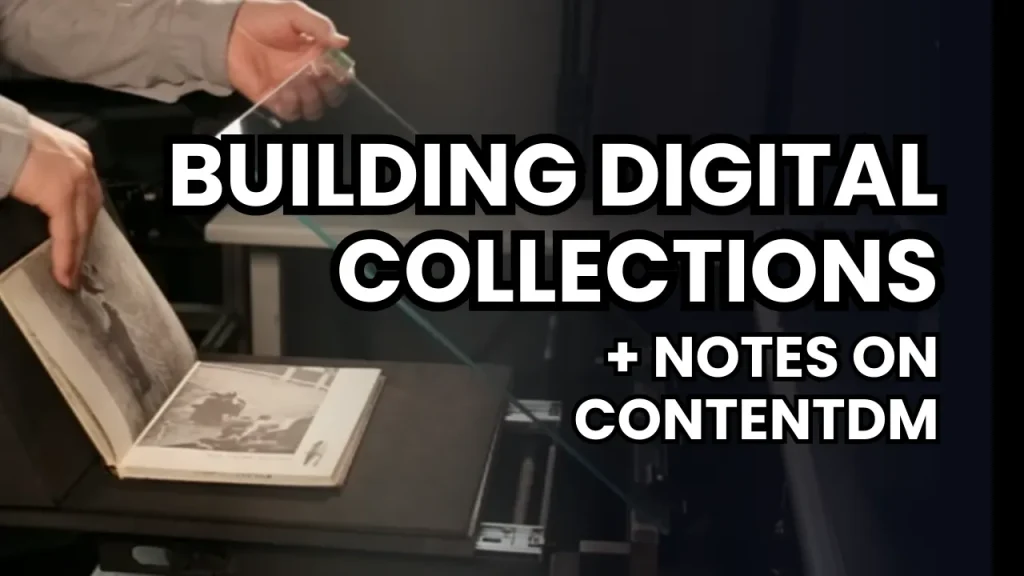
When preparing to outsource a digitization project, what exactly should you expect? What advantages does your vendor bring to the table? Which steps will you outsource, and which steps might your staff handle in-house to reduce costs?
In this webinar, Caitlin Costalas, digitization project manager at Backstage Library Works, and Kelly Barrall, vice president of digitization services, offer a vendor perspective on preparing for digitization projects. They’ll also answer your questions.
Topics include:
- Identifying your audience so you can plan to meet your users’ needs.
- Organizing your collection to minimize material preparation costs from your vendor.
- Leveraging a vendor’s capacity to scale up digital image production.
- Choosing sources of metadata and defining what information will be collected.
- Working with a vendor to build your CONTENTdm collection.
Implementing RFID Without Turning Your Library Upside Down

When your library implements an RFID system, the RFID tag is the least expensive piece of hardware. But with tens or hundreds of thousands of tags to be placed, tagging your collection is the stage of implementation that will take the most time and has the most potential to disrupt staff workflows and interfere with patron access to your collection.
Issues to address range from planning how to manage consistency and quality control, to deciding whether to close the library during tagging, to establishing workflows for intercepting untagged items while the collection continues to circulate.
In this webinar, Jacob Bastian, vice president of on-site services at Backstage Library Works, walks you through these decisions and highlights areas that need your attention from the early planning stages.
Digitizing the Leffingwell Scrapbooks: A Study in Complex and Fragile Materials
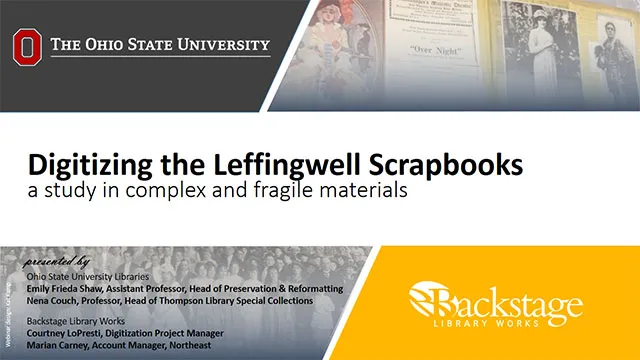
Where do you start when you want to digitize a collection of complex and fragile materials?
The Lawrence and Lee Theatre Research Institute at The Ohio State University Libraries holds, in its Leffingwell Collection, scrapbooks that document American theatre performances from the late 19th and early 20th centuries. These scrapbooks include loose items, folded sections, and acidic paper mounted on base pages of nearly transparent tissue.
The project of digitizing these scrapbooks presented numerous challenges, from choosing which volumes should be converted to deciding how to handle long newspaper clippings, loose bindings, and detached covers, as well as brittle, creased, and dog-eared tissue pages.
In this webinar, Nena Couch and Emily Shaw, of The Ohio State University Libraries, and Courtney LoPresti, of Backstage Library Works, describe the process of selecting and preparing these materials for digitization and discuss decisions that were made before and during the digital imaging process.