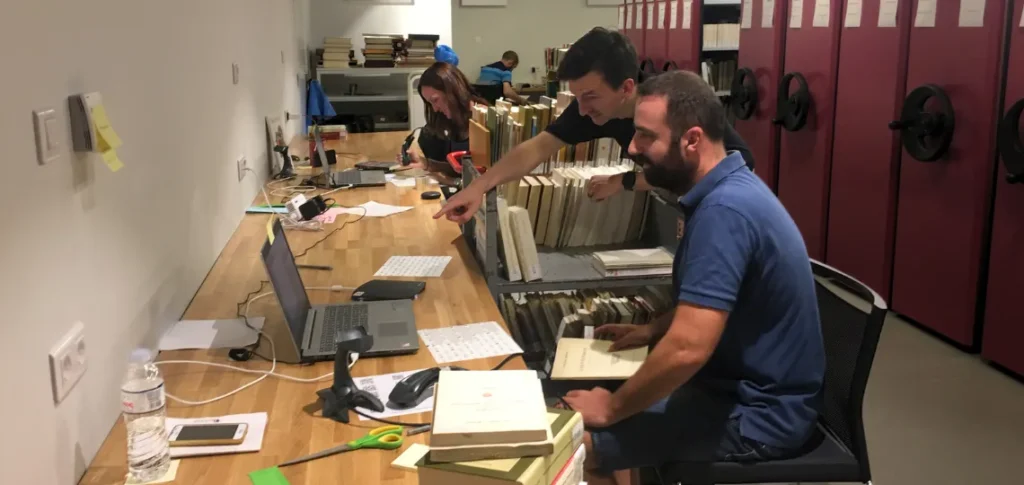


When the reorganization project has been approved, the deaccession list pulled together, and the collection made ready for upcoming changes, you’re in the clear to move on to the next phase: making it happen. While the planning phase is often complicated, execution can bring challenges of its own. How do we weed and shift books without restricting patron access? Do we have the time to complete the project with our own staff, or will we need student workers? Contractors? Who will manage the project?
The Backstage On-Site team has been responsible for conducting hundreds of inventories, RFID tagging projects, weeding assignments, and reclassifications for public and academic libraries alike. Sometimes projects are managed locally; others are fine to be coordinated remotely. We’ve worked with staff, student workers, and handled onboarding teams of temporary employees. Our standard practice works around the needs of patrons and staff. How does it work?
Write the ‘Gameplan’ – The Project Overview
With your objectives in hand, you’ll meet with a dedicated Backstage project manager to start coordinating a schedule of operations. This will often include creating some milestones: sensible divisions of work that create measurable goals. Timelines are attached to these milestones, so if something begins to get off schedule, it’s easier to know what’s causing the delay and how that may impact deadlines.
The project overview will also outline the order in which things should be accomplished. Which sections need to be prioritized? Which will be considered ‘under construction’ during which phases of the project, and how do workers and staff need to interact with one another to keep concurrent tasks running smoothly?
By the start of the project, there will be a written, shared proposal in place for everyone to reference. It will detail the different points of contact between all stakeholders, declare a concrete scope for the project and its individual objectives, and tie these all back to an overarching timeline.
Run the ‘Play’ – Make It Happen
Teams are hired and trained as needed, and the Backstage project manager oversees all stages of their on-site projects. That isn’t to say the library can’t be involved; the level of collaboration or degree to which you are ‘hands off’ is up to you.
Progress is measured regularly throughout the project, as is quality assurance—a keystone element of all Backstage projects. What that looks like depends on the project being conducted. Often, a portion of ‘completed’ shelves are given a second check to ensure the right items were labeled, tagged, shifted, pulled, etc.
Communication between the library staff, the project manager, and the team conducting the work is a continuing factor in the success of large projects.Reports are shared on a weekly basis, at minimum, with flexibility to increase that communication as needed or desired. When conducting RFID tagging or reclassification projects, we also find it helpful to set up a whiteboard that details the day’s happenings at a central point of the library, where it can be referenced by everyone.
When conducting weeding projects, our team starts with a library-supplied pull list (a spreadsheet of titles, ISBNs, or barcodes, for example) and staff, assigned into teams, work their way systematically through the stacks. Books are deaccessioned as they go, and the titles are collected into a central processing hub where they can be boxed or recycled.
Wrapping Loose Ends
The goal is to leave your library feeling refreshed; to that end, we are careful to keep areas clean as we work, and fully tidied before we leave.
Books pulled during weeding have a couple of options for disposal. Backstage often works with Better World Books to donate eligible titles. Those not taken can be recycled according to local practices. Some libraries prefer to hold onto certain materials with the intention of hosting book sales.
The name of the game with on-site projects is: customization. Every library is unique, every project has its quirks, and our approach is always to tailor our flexibility and experience to the project that you’ve prepared. We know how to keep projects moving forward and stay on target, and we’re happy to apply that knowledge to your next project.
What project do you have coming up? Chat with our team at info@bslw.com.