
We offer an on-site workflow for nearly every service department at Backstage and in this blog, we’ll explore a couple of examples, like our surrogate capture workflow for a special metadata project at the Oak Spring Garden Foundation and the multiple digitization projects performed on-site with The New York Historical.
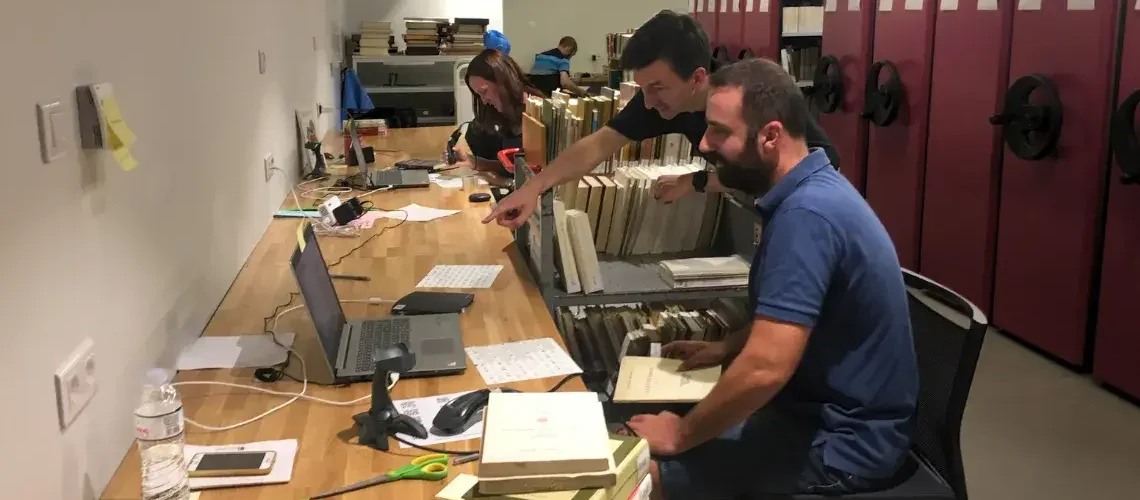
Backstage Library Works has three primary offices. There are two in Bethlehem, Pennsylvania, and one in Provo, Utah. The majority of our projects involve shipping materials to one of these centers, but in some cases, it makes more sense for our team to work on-site with the library at the collection’s home.
- When collections are unusually fragile or extremely unique, you may feel more comfortable keeping them close to hand.
- If you have researchers frequently accessing your collection, having the work performed on-site eliminates shipping times, meaning patrons don’t have to wait as long to get back to their personal projects.
- Backstage is no stranger to multi-year, high-volume projects—still, for very lengthy and large projects, it may make more sense to set up at your library in order to get the job done.
- Some projects can only be done on-site, like converting to RFID or performing an inventory review.
To get an idea, let’s explore some different workflows Backstage has used in the past to complete a wide variety of collection management goals at libraries and museums across the United States.
Adding To & Updating Catalog Systems
Professional catalogers of various formats and languages have been sent, hired, and temporarily established at a number of state and special libraries across the East Coast. With one institution, Backstage catalogers reviewed oversize maps and performed copy and original cataloging in Evergreen ILS. With another, we had the opportunity to work with master molds, discs used to mass-produced phonographic records from the early 20th century. As the collection had unique needs, both in regards to material storage and database management (which lived inside of a closed-connection), the project required one cataloger to work on-site for two years.
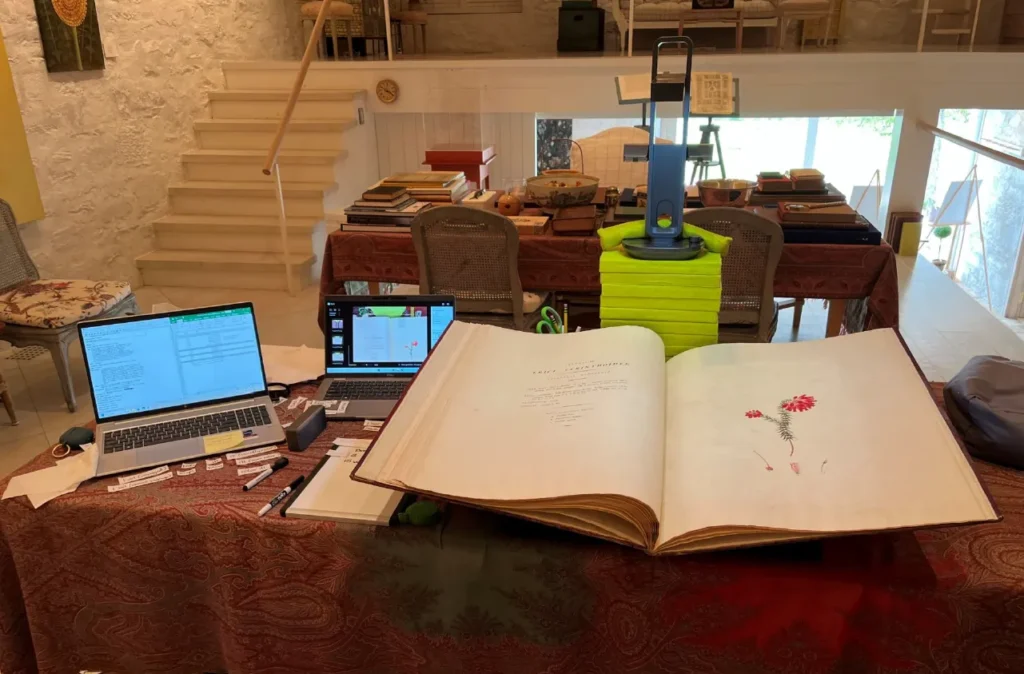
Backstage pursued a unique cataloging workflow with the Oak Spring Garden Library. The collection was originally assembled for the use of a single individual, Rachel “Bunny” Mellon. Included today are manuscripts and rare printed books that focus on plants, garden design, and natural history. These materials were attached to deep, detailed metadata, but arranged in systems that had changed over the years. Records that had been inputted during the early period of digital conversion were missing diacritics because older systems did not always support special characters. While enough information was available to derive a modern MARC record of the data, the lost characters could only be readded with access to the materials.
Rather than send the unique collection to one of Backstage’s offices—and only for the sake of covers and title pages—a technician arrived at the Foundation, staying in a research house for the duration of their visit, to create digital surrogates. The flexible arrangement helped protect the original materials, save on shipping costs, and the project has been progressing excellently.
Assessing Archival Collections
Whether it’s arranging a collection or simply preparing it for a future stage in its life, our archival team has worked at a number of libraries to serve a variety of different needs. The Grand Rapids Public Library has an inventory of approximately 11,500 containers in their archives. Before the library approached its future collection goals, Backstage was tasked with performing a pre-assessment that included going aisle by aisle, box by box to measure each container, check the contents of each and record the findings into a spreadsheet and ArchivesSpace. The materials contained within varied, from the usual material to some less expected things like a scrapbook with locks of hair to photos of a Vaudeville strongman act. At the conclusion of the project, non-archival fastenings and packing materials had been removed from carriers, damaged containers were replaced, and everything was barcoded awaiting the library’s archivists’ next steps.
FADGI-Compliant Digitization
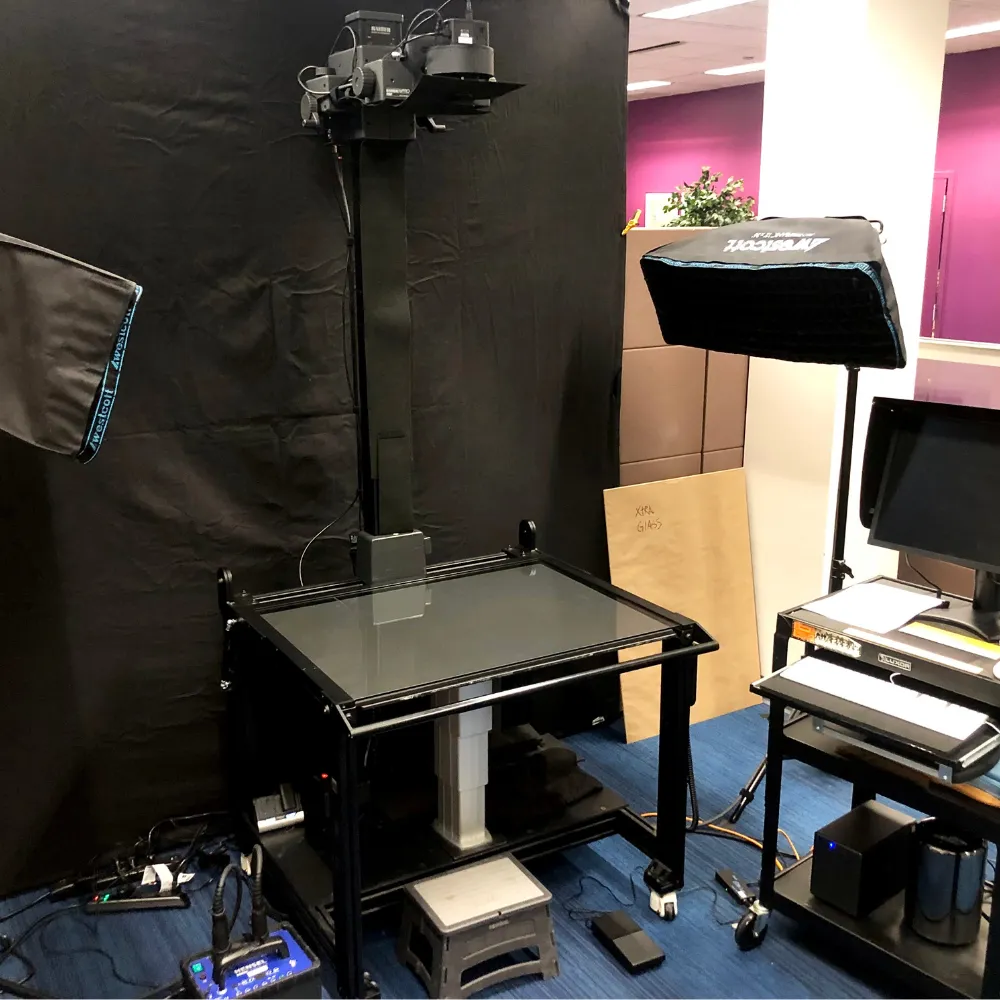
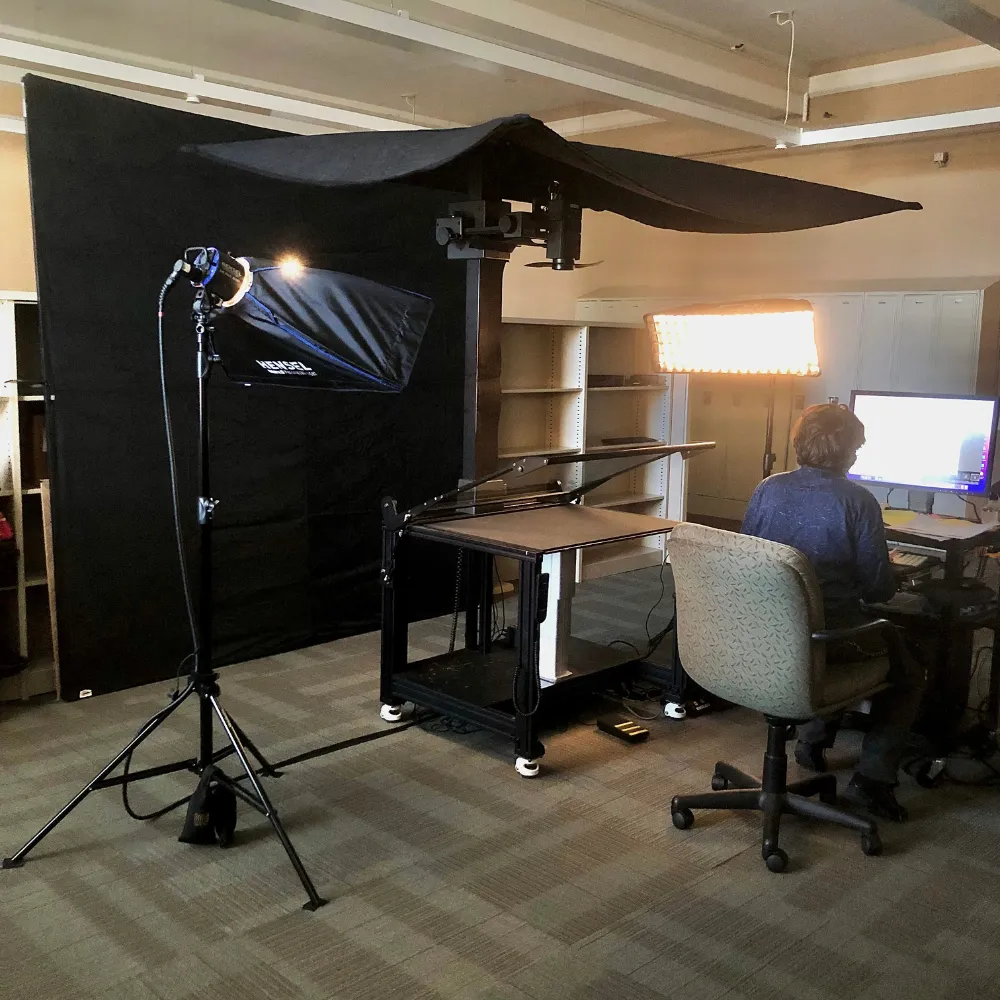
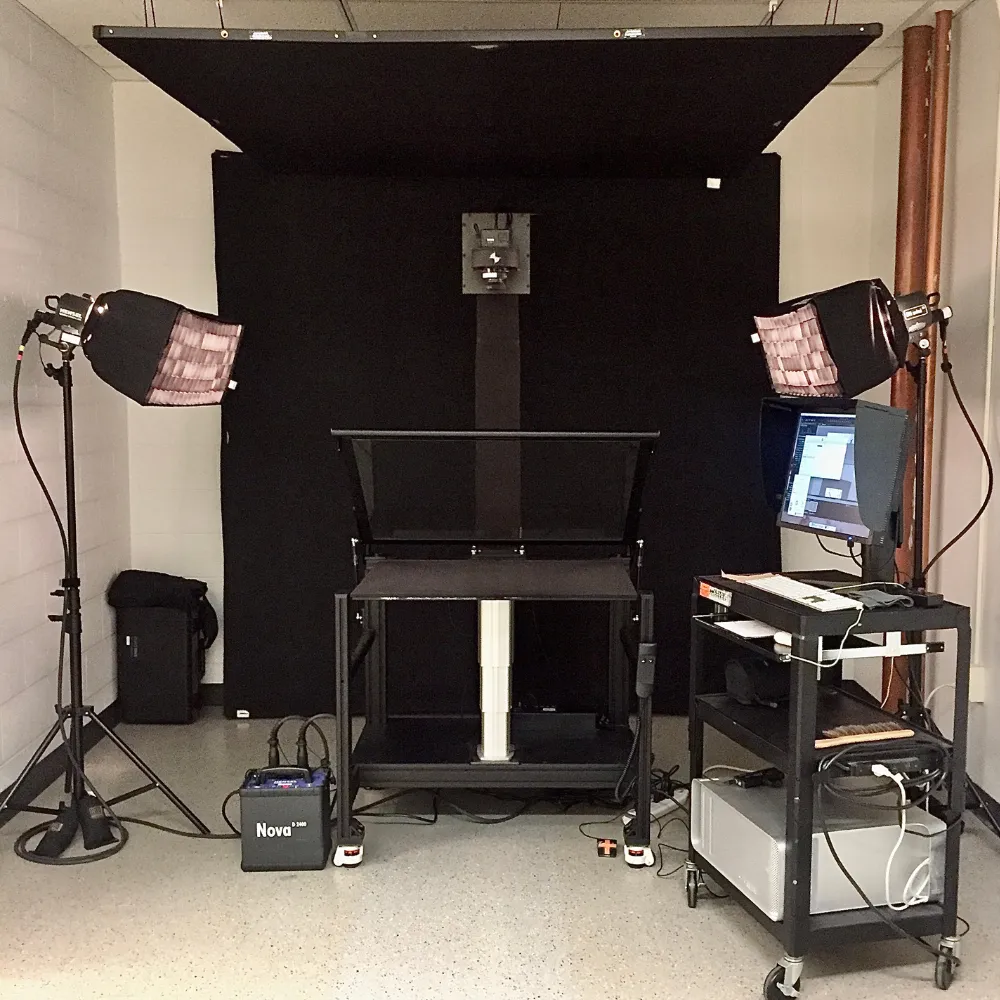
Digitization projects typically require a specialized environment and workflow that features high-end equipment, thorough quality assurance patterns, and a lot of training. It may seem that a transportable version of this ecosystem would be complicated, if not impossible. However, we have been setting up cameras—flash units, curtains, and all—for over a decade. Equipment is sent in a custom-fitted crate and assembled by two members of our technical team. We can do a lot with a little as long as a few requirements are met by the space in which we set up including, among a few other things, the size of the space and access to power.
Several notable on-site digitization projects have been completed at The New York Historical. “Although we’ve often sent collections off to Bethlehem for digitization,” explains Henry Raine, Director of The Historical’s library digital program and repository, “these particular collections needed to be digitized on-site due to their intrinsic value, and also because they were too difficult to prepare for transport.” Between 2022 and 2023, Backstage set up a camera to digitize many materials related to the history of Long Island, and a collection of Sebastian Bauman’s correspondence from 1775-1795. Before that, Backstage was tasked with digitizing a large volume of Civil War manuscripts in 2012/2013.
“In the Long Island project, the maps ranged widely in sizes, as did the broadsides, and were difficult to pack for shipment off-site. The condition of the manuscripts also varied a lot, with some especially fragile collections needing to be handled with help from our conservation staff during capture.” On-site collaboration with archival and conservation staff can be a huge benefit to capturing work close to home.
Physical Collection Management & Inventory Review
Our team was able to support a large-scale inventory and relocation project at a major university library. Through the course of a broader campus reorganization, the library required a complete and detailed inventory of its physical collections to ensure all materials were trackable and made the journey safely to temporary new housing.
“Our team worked on-site to process approximately 200,000 items,” describes Matt Roveto, Operations Manager of On-site Services at Backstage. “This included standard and oversized volumes across multiple sub-collections and shelving systems. Each item was scanned and verified against pre-printed inventory slips, which were then physically inserted into the materials.” The project also involved moving thousands of linear feet from overflow storage back into the main stacks to align with an updated shelf order.
Huge, physical collection management projects can be daunting, often a milestone in the developmental history of a library. It’s for that reason that our team specializes in making these projects as simple for clients and as non-disruptive to patrons as possible, tackling things like physical reclassifications and RFID tagging without the library needing to close.
Consultations
Most projects require an initial review stage and that’s why our team is always willing to assist with consultative work. A great example would be microfilm collections: our team has been asked several times to assess whether a collection was acetate, polyester, or a mix of the two. Knowing what you have can make a big difference on how you maintain the collection. Polyester and acetate microfilms have different climate recommendations and, ultimately, acetate microfilm must eventually be converted as it’s not suitable for preservation. By the time your shelves smell like vinegar (the tell-tale sign of acetate deterioration) damage is already being done—and quite quickly. Understanding the risks your collection faces ahead of time helps you to plan your preservation steps and make decisions without having to rush through a remedial solution.
We can consult on other topics, too—not just on microfilm. If you have been holding off on planning an outsourcing project because you’re not certain if the materials can travel, reach out to us at 1.800.288.1265 or send an email to info@bslw.com and we can talk through options.