


Collection management projects are ultimately tools to optimize the space and discoverability of library collections. Inventories, reclassification, RFID implementation, and shelf-shifting projects are great projects to consider outsourcing, which allows for the least interruption of day-to-day operations.
When thinking about libraries, ‘book’ is typically the first word that comes to mind. Yes, libraries have books—and DVDs, and other forms of media; public computers and study spaces; special programming and events. Managing a library is a great deal more than caring only for books, and librarians are tasked to consider their materials and the space they fill wholistically.
Large-scale collection management projects are those which massively alter the organization or arrangement of materials, and they tend to be complicated to manage on top of staff’s usual responsibilities. Vendors like Backstage can assist by sending teams on-site to complete the work without disrupting day-to-day operations. How do these projects impact the library, and why are they important to consider?
The Diagnostic Gold-Standard
Libraries should perform inventory reviews on a regular schedule where possible. The frequency depends on the size of the collection, its rate of circulation, and the timing of other large-scale projects. Every item on every shelf is scanned to see if it corresponds to a set of bibliographic, item, and holding records. This systematic review reveals important operational information: what books are missing item records or even barcodes? What items are present in the catalog but missing from the collection?
While inventories are typically performed all at once, it may be easier for your library to confront the project in pieces, particularly when laying out a schedule for ongoing maintenance. Once-annual review of subsections within the library can help you stay on top of your physical catalog.
Improving Operability
Reclassification projects are becoming more frequent, particularly as some libraries choose to move away from Dewey into other keyword-based classification systems, or even to the Library of Congress Classification scheme. Why reclassify? To make things easier for patrons to find, and to make collection growth simpler to accommodate. After the bibliographic data is converted, the physical collections need to be updated as well with each book getting a brand-new spine label and position on the shelves. This is another type of project where having additional and temporary staffing through a vendor can make the process a little easier.


More things are becoming possible with RFID tags. Security is just a small part of what they can provide; some technologies are exploring how RFID tags may be used to speed up inventory assessments, and they allow patrons to check out their books on their own. Implementing it involves working with a distributor, such as Bibliotheca and Envisionware, to handle the equipment and purchasing side of things. However, libraries can also partner with companies like Backstage to take care of applying the labels to every book in your collection.
Reconsidering Arrangement
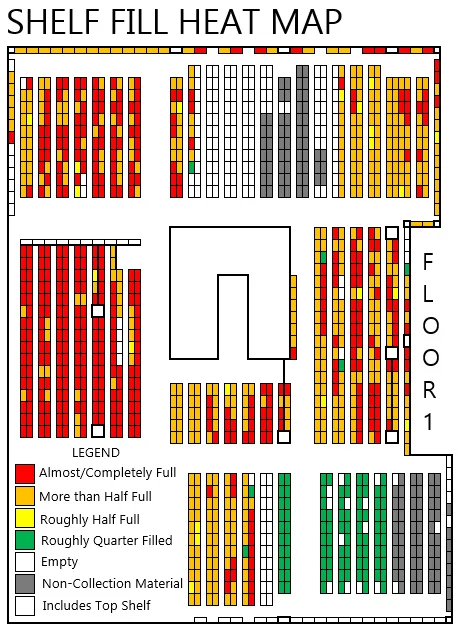
Collections fluctuate. The space allotted to one subject may have been sufficient a few years ago but be a poor fit today. When the arrangement of materials begins to be a problem for purchasing and shelving, it’s time to shift things around or deaccession titles—or, both. When you generate a list of titles to weed, our team will handle pulling and removing the materials from your shelves and catalog. From there, we can look at your shelves, from the emptiest to the most densely packed, and create a heat map that visualizes the available space in your library.
What genres do you purchase the most of? Is there an upcoming renovation to account for? These factors should be taken into consideration when reconfiguring the layout of materials.
Considerations on Collection Management
In many cases, weeding, collection shifting, reclassification, and RFID implementation are interconnected parts of larger space-planning initiatives rather than standalone projects. While these may be “projects” throughout the lifetime of a library, they are just as much tools that can help to maximize physical space, improve discoverability, and adapt collections to fit the changing needs of patrons.
While these projects can be very large, multiple initiatives can typically be carried out at once as the processes work harmoniously with one another. Reclassifying? This would be a good time to make a quick deaccession list, and once everything has been relabeled and tidied (with the weeded titles set aside for a book sale or recycling), the remaining books can be redistributed on the shelves.
What large-scale projects do you have awaiting your collections? Tell us more and reach out at 1.800.288.1265 or send an email to info@bslw.com.