
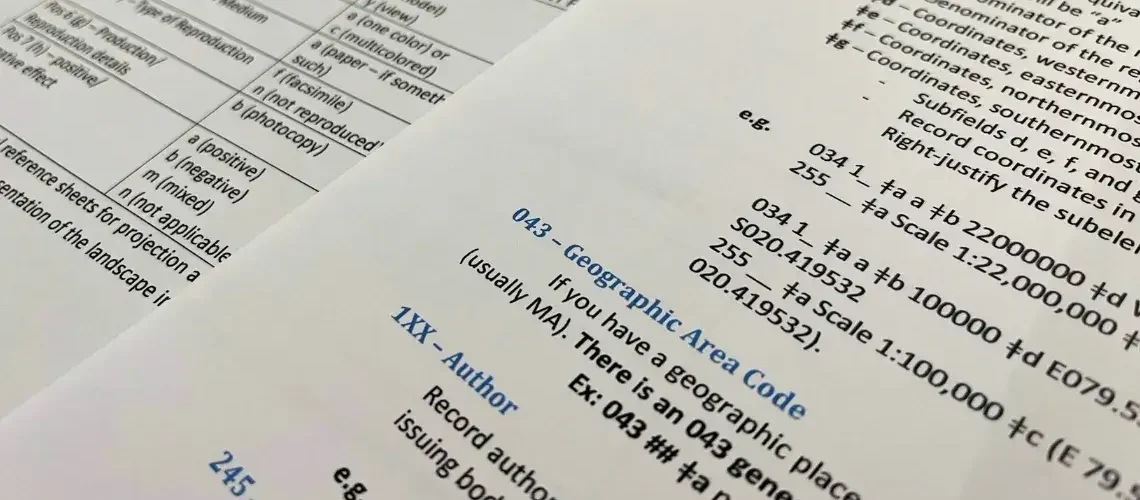

We prioritize having a flexible approach to cataloging. Underpinning our project planning stage, the period of time in which Backstage and the library arrange how a collection will be processed, is the Backstage Record Element Set. It is “square one” and the tool we use to bring everyone into alignment. As a groundwork, Backstage and the library can then discuss options for customization.
RDA Core, RDA Core If, BIBCO and PCC, DCRM, CONSER—many guidelines exist for creating a MARC record, with local and international standards often commingling in a library’s processing specifications. While much of it is standardized, there is room enough for variations that contracting with a vendor meets the surprising obstacle of making sure everyone agrees: Just what is considered standard in a record?
What is the Backstage Record Element Set
Ultimately, Backstage’s RES is a set of guidelines that were designed to provide a foundation for developing a project’s MARC specifications. It pulls from existing frameworks, and it meets the baseline requirements for RDA Core and most of the elements required by PCC—for more typical monographic formats as well as audiovisual or rare materials. This helps the library and Backstage’s cataloging team start from the same page.
It covers the following:
- Essential descriptive and access elements, meeting all of the baseline fields required by RDA while following BIBCO’s guidelines for entering main entries, titles, publication information, extent, and identifiers such as ISBN.
- Discovery and shelving information, including the addition of a call number and up to five subject headings in a given classification and vocabulary—these to the preference of the library with the most common requests being Library of Congress classification and subject headings, Dewey, BISAC, or MeSH.
- Added entries (largely pulled from BIBCO’s recommendations for contributors), non-Latin script and transliterations, and 5XX notes.
With an established element set in mind, libraries can then opt for changes or additions:
- Adding controlled vocabularies or classifications (for example, a Dewey number as well as LCC).
- Having Backstage perform shelflisting as a part of the delivery (typically requires remote access to the ILS).
- Expanding the added entries past five where contributors are plentiful and important to be noted.
- Chapter-level contents notes, summary notes, or transcriptions.
- Translations into English of the title, contents, series statement, etc.
Local fields such as holdings statements and item level data can also be ingested into records produced at Backstage.
Finding the Fit
While many of our partner libraries elect for full-level copy and original cataloging, there are certain situations where brief records are sufficient. For the collections that need minimally-populated bibliographic records as placeholders in the immediate, Backstage can instead search for copy records, save matches, and move on without further (or little) editing. Original records can also be slimmed down in certain use cases. To an extent, the cataloging process can be considered modular.
A core belief at Backstage is that every collection is unique. One size does not fit all and, sometimes, libraries require a greater flexibility than the options presented above. Time and again, the most frequent question we are asked is whether or not records can be customized—yes! Absolutely.
If you have a local practice that requires a special approach, reach out to us at 1.800.288.1265 or send an email to info@bslw.com.