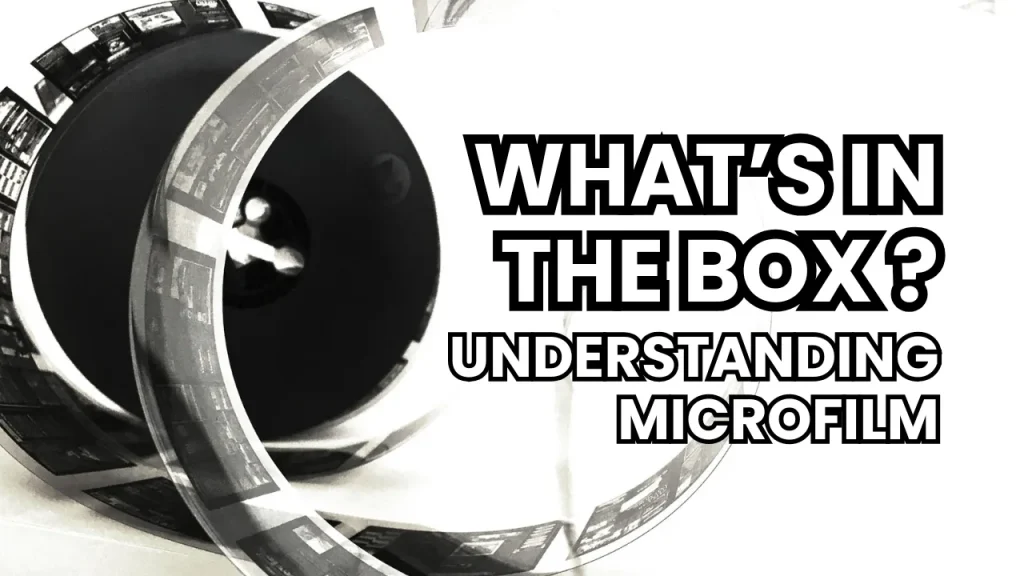
What’s in the Box? Understanding Your Microfilm Collections
Over the last century, libraries around the world have preserved countless newspapers, books, and archival collections on microfilm. Some microfilm reels were produced for distribution and widely circulated, while others contain the best surviving copy of unique local history and genealogy resources.
When was the last time you considered your institution’s microfilm collections? Do you have acetate film, susceptible to vinegar syndrome? Is the content findable in your catalog? Which resources would be of interest to your community if they were easier to discover and access? Where do you even start?
In this webinar, Beth Brevik, account manager and former microfilm project manager at Backstage Library Works, leads you through exploring your microfilm collection, understanding what you have, assessing potential risks, considering long-term preservation, and finding ways to make these largely hidden collections available to your patrons.
History of MAPS – Micrographic Preservation Service (1992)

MAPS was founded in 1985 by five research libraries: Columbia University, Cornell University, New York Public Library, New York State Library, and Princeton University. Their goal? “To adhere to the highest standards of preservation microfilming, and to create a high quality, low cost microfilming service for nonprofit organizations.” An alliance between MAPS and OCLC was formed in 1990 and, in 2009, the former MAPS center became a part of Backstage Library Works.
In 2024, this video was rediscovered by members of our Microfilm and Digitization teams and restored. As we watch through it, it’s fascinating to see how much has changed in the decades since, and how much remains the same. What has persisted is a dedication to the preservation of heritage materials, utilizing workflows that ensure high-fidelity capture of original materials.
From Paper to Film: Microfilming and USNP at UIUC

Digitized newspapers are an invaluable resource for searching local history and genealogy. Today’s digital newspaper collections owe much of their content to microfilm produced for the U.S. Newspaper Program (USNP) from 1982 to 2011. But what role does microfilm play in the preservation efforts of a modern library?
In this webinar, guest presenter William Schlaack, digital reformatting coordinator at the University of Illinois at Urbana-Champaign, shares how microfilm fits into the University Library’s preservation program. He explains why and how UIUC continues to expand its microfilm collections, presents an overview of the microfilming process, and discusses considerations to ensure that your microfilm collections are ready to digitize.