
ILS Migration Migraine: Tips for Prevention and Recovery
Moving to a new ILS is an enormous undertaking that involves stakeholders from across the org chart. The library catalog is one core aspect of an ILS change. What steps can you take to prevent the predictable headaches of your bibliographic data transition? What can you do to optimize your metadata before a move? What problems may pop up during the process? And what remediation might be necessary after you transfer your MARC records? In this webinar, Casey Cheney, vice president of automation services at Backstage Library Works, maps out common issues and opportunities that librarians encounter with their catalog metadata during an ILS migration. In this webinar, Casey Cheney, vice president of automation services at Backstage Library Works, maps out common issues and opportunities that librarians encounter with their catalog metadata during an ILS migration.
Cataloging Surrogate Capture Demonstration

This demonstration is taken from our webinar, Cataloging at a Distance: Capturing Surrogate Images for Remote Catalogers. Here, Jake Bastian talks through the process of scanning a book using our Scan-to-Catalog kit.
Kits include:
- Laptop (with charger, mouse, and pad)
- CZUR Shine Ultra Pro Scanner (with power cable, USB cable, foot pedal, and capture area mat)
- Hard drive with USB cable
- Supplies (whiteboard, markers, eraser, ruler, acid-free paper flags, lint roller, and screen wipes)
Contact Backstage for more information and a guide for what images to capture when generating cataloging surrogates.
Cataloging at a Distance: Capturing Surrogate Images for Remote Catalogers
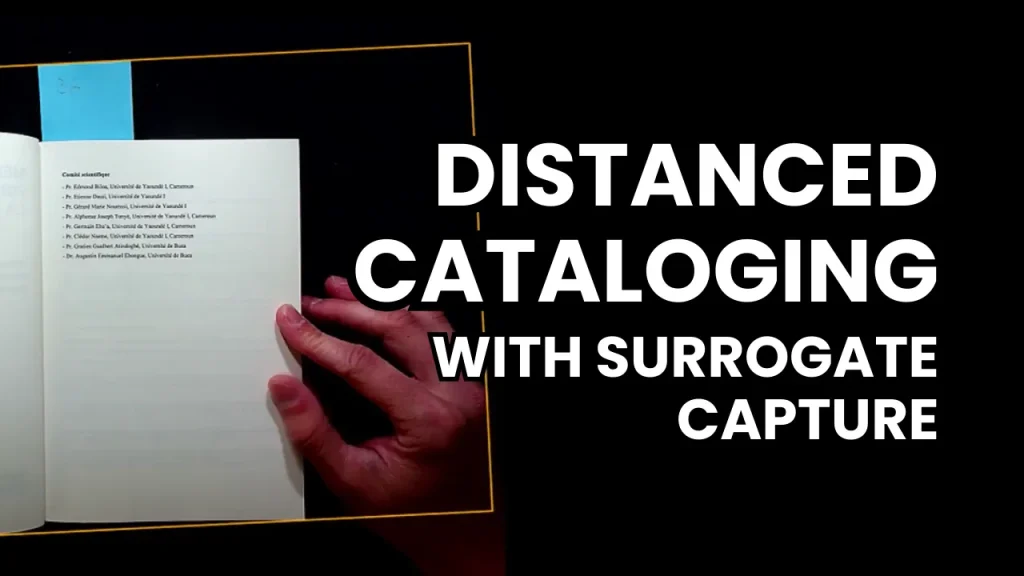
Metadata operations in libraries aren’t public-facing. They generally aren’t high-profile. But organizing information is at the heart of librarianship, and cataloging makes access possible.
Creating cataloging surrogates can empower a library’s metadata team to streamline workflows, to operate with greater flexibility, to cultivate a network of language, format, and subject expertise, and ultimately, to increase access to collections.
In this webinar, Jake Bastian, vice president of collection management services at Backstage Library Works, explores the practice of creating and working with cataloging surrogates, the reasons for adopting this tool, and how to integrate surrogates into your cataloging workflows.
Cataloging Zines: Discovery for Micro-Publications and Niche Collections
Zines create a fleeting snapshot of culture, often with a tight focus on a specific time, place, and like-minded community. Libraries are increasingly curating zine collections for circulation to readers and to preserve as history. However, the non-traditional nature of these publications raises practical questions for how to manage them in a discovery environment.
In this webcast, guest presenter Nicole Lewis explores zine collections from a bibliographic standpoint. She covers decisions to be made in cataloging zine collections, MARC fields that merit particular attention, and useful online resources from libraries and the zine community.
Nicole Lewis is the lead cataloger at the University of Utah’s J. Willard Marriott Library. She is responsible for coordinating cataloging workflows, LMS system administration for cataloging and acquisitions, and she performs cataloging for zines and a variety of other materials. Prior to her current position, Nicole worked at Backstage Library Works for a number of years.
Optimizing Catalog Metadata: Ensuring Discovery and Access in Our Libraries
In the wake of a sudden shift toward remote access, librarians are re-assessing priorities in making collections accessible to patrons who are unable to visit the physical library. Metadata maintenance efforts can be crucial to facilitating this change.
In this presentation, guest speaker Tom Adamich explores the challenges and opportunities of a renewed focus on library metadata. He’ll discuss assessment and optimization of catalog data, as well as the roles a vendor might play in support of a library’s plans.
Tom Adamich is a professor and technical services and reference librarian at Monroe County Community College, and president of the Visiting Librarian Service.
Implementing RFID Without Turning Your Library Upside Down
When your library implements an RFID system, the RFID tag is the least expensive piece of hardware. But with tens or hundreds of thousands of tags to be placed, tagging your collection is the stage of implementation that will take the most time and has the most potential to disrupt staff workflows and interfere with patron access to your collection.
Issues to address range from planning how to manage consistency and quality control, to deciding whether to close the library during tagging, to establishing workflows for intercepting untagged items while the collection continues to circulate.
In this webinar, Jacob Bastian, vice president of on-site services at Backstage Library Works, walks you through these decisions and highlights areas that need your attention from the early planning stages.