
Resources that allow light to pass through them are called “transmissive”. This includes slides, photographic negatives, microforms, glass plates, and all manner of film: motion picture, aerial, and more. Digitizing these materials can be complicated. They are often delicate, they come in odd shapes, and there are additional factors to consider that you don’t typically have to think about when digitizing paper (which is considered a reflective material). However, there are some big upsides to digitizing straight from a negative, the most important being, often, a higher level of detail than that contained in a print reproduction.
What are some of the obstacles involved in the process and how do we overcome them?
Adaptations to Process
Let’s start with the most practical arrangements.
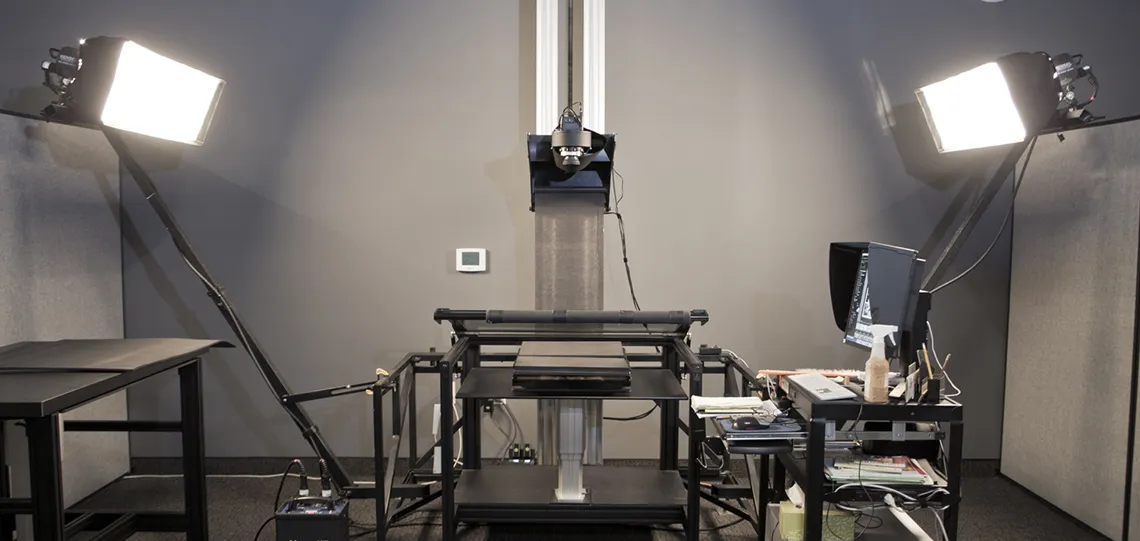
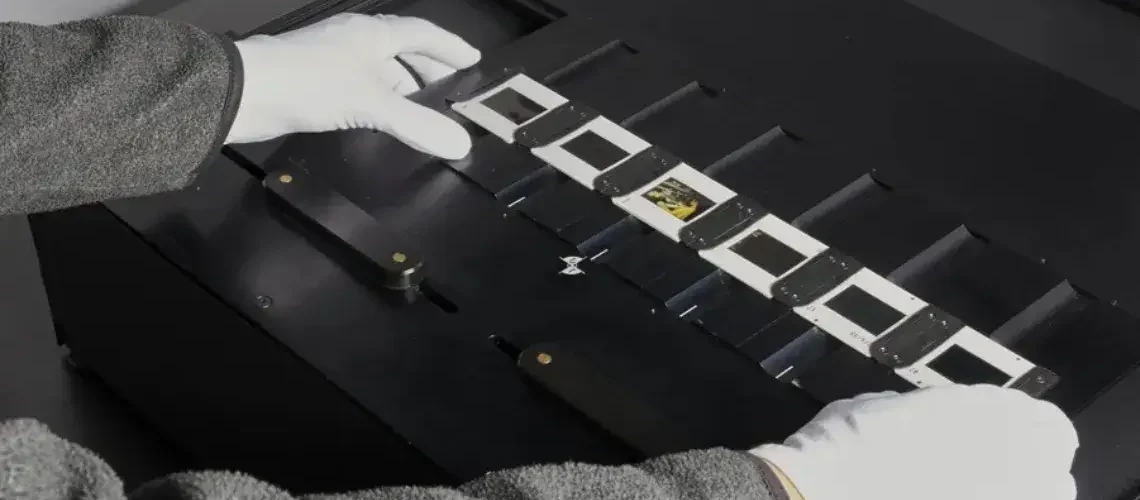
Film sometimes has a natural curve. It also comes in different sizes and shapes: reels and sheets, small and large. The best solution is to have equipment that excels at being customizable. Slide holders adjust to accommodate paper, plastic, and metal slide mounts; orbital cameras allow for closer or further capture ranges.
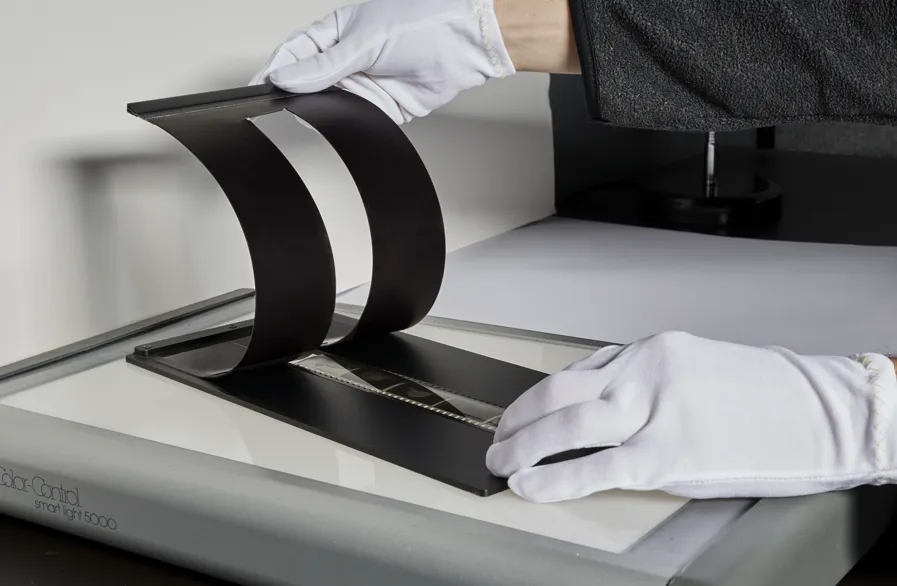
The emulsion layer of film is sensitive to heat. Some film, too, can be reactive, meaning a lamp that’s too hot might permanently affect the tonal quality. When this is the case, we use cold light transilluminators which provide plenty of light for digitization but without the risk.
Film is susceptible to scratches and it’s one of the few mediums where you do want to wear gloves (100% nylon or cotton, or nitrile when handling glass plates)! To protect it from dust and pollutants, film is typically stored inside of something, be that a box, a folder, or sleeve. Therefore, the capture process looks something like this:
- Wearing gloves, the technician will remove the film from its housing.
- Debris is cleared using ionized compressed air. Never use a brush or towel!
- After the image is captured, the film is returned to its housing.
It’s good practice to dust off equipment every so often throughout a scanning session. Particulate can damage film; keeping the area as tidy as possible is your best security.
Polarity and the Speculative Artist Intention
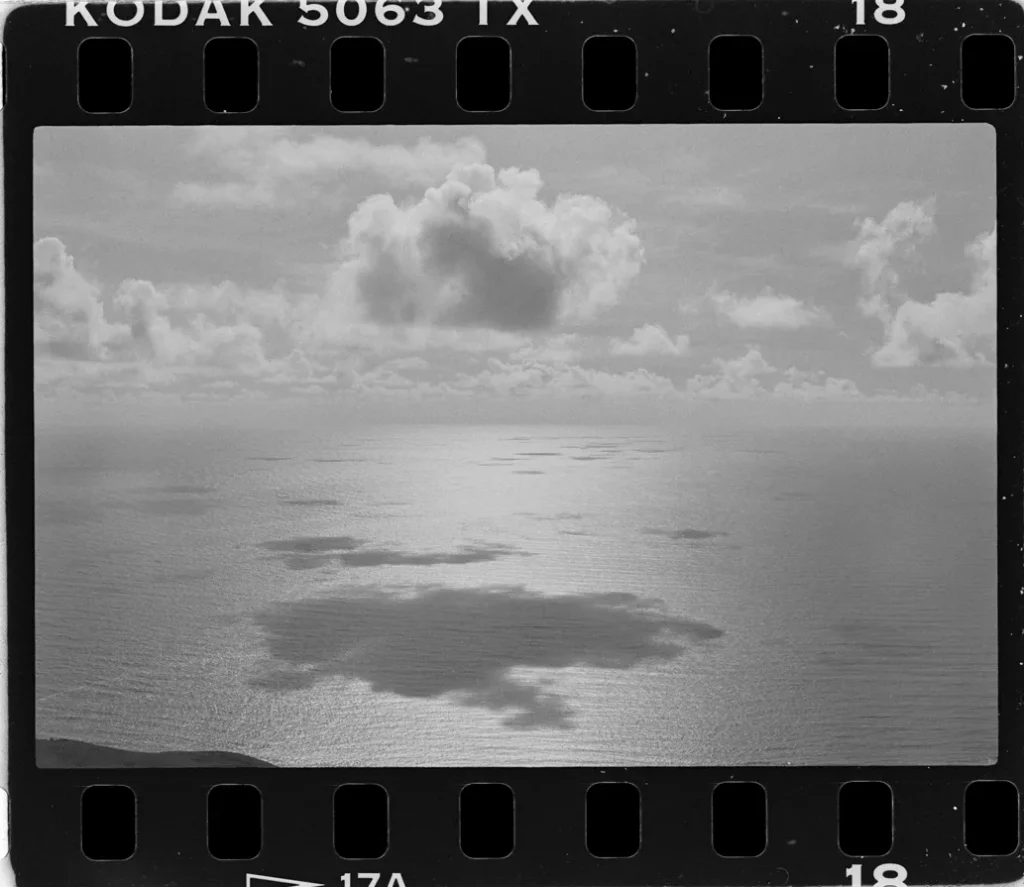
Negative polarity film has reversed colors and tone – whites are rendered black; lights are rendered dark. Positive polarity films, then, are opposite to that. Both polarities require some level of color calibration during (and sometimes after) digitization to most accurately represent the intended final result.
Not all film is exposed the same. “A roll of film can contain various scenarios from indoor to outdoor situations or day and night scenes which will change the consistency of the film exposures,” explains Mike Cabreza, assistant manager on the Digitization technical services team. Color film is standardized using special targets: IT8 in addition to the ISA Standard Film target, to provide accurate calibration. Film scans will often require post-processing to adjust the final result. These color correction programs with scene-balancing algorithms allow the team to tweak the color balance without incurring information loss on the file.
“The digitization of film poses aesthetic questions that are largely absent in the digitization of reflective material,” adds Mike. “The biggest difficulty when digitizing transmissive material is achieving what is known as the speculative artist intention; that is, what the photographer intended the final image to look like. It takes a lot of experience with the process of analog photography to understand the various options of presentation.”
Familiarity
For as much as is different, some things stay the same. Digitization of any format should be undertaken in a FADGI compliant facility where ambient light and reflectance are controlled and the workflow helps maintain high quality, high fidelity results. The best results are often obtained when the capture technician has a passion for photography and the preservation of cultural heritage materials.
Many formats pass through our studio: posters, papers; manuscripts in great, or not so great, condition; microfilm, glass plates, and even three-dimensional objects. If you have questions about the process used to digitize one material over another, you are always welcome to reach out to our team 1.800.288.1265 or send an email to info@bslw.com.